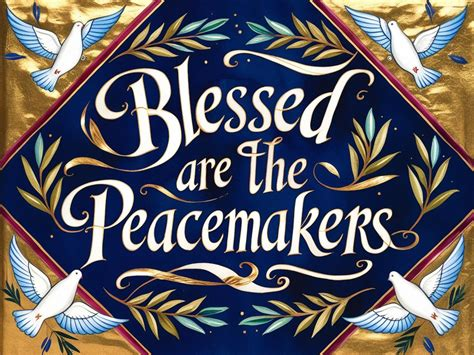
Our verse of the year this year is Matthew 5:9 –
Blessed are the peacemakers, for they shall be called sons of God.
This is, of course, one of the Beatitudes, the teaching of Jesus from the Sermon on the Mount. But by talking about peace from the words of Jesus, we’re jumping into the middle of the Bible. The idea of “peace” has a long and storied history and meaning that builds into this beatitude from the Old Testament. The Hebrew word for peace is shalom, and Jesus is saying that His blessing rests on those who make shalom.
The word shalom is commonly translated peace, but no single English word captures its richness. Shalom means wholeness, completeness, flourishing, harmony, welfare, and right relationship. It describes life as God intended it: a world where every relationship is ordered according to His wisdom and law and love.
In the Old Testament, shalom appears well over 200 times and touches nearly every dimension of life. It refers to personal well-being (Psalm 4:8), healthy relationships (Genesis 26:29), national prosperity (1 Kings 4:25), covenant faithfulness (Numbers 25:12), justice (Isaiah 32:17), and the future hope of the Messiah’s reign and God’s redeemed creation (Isaiah 9 and 11). To ask, “Is it well?” was literally to ask, “Is there shalom?”
But shalom is never merely the absence of conflict. A nation may be free from war yet still lack shalom. A family may be outwardly peaceful while inwardly fractured. Biblical peace is the positive presence of God’s order and blessing.
The story of the Bible is the story of shalom, its creation, fall, and redemption.
The story begins in Eden. Creation itself is the first picture of shalom. Humanity lived in joyful fellowship with God, with one another, with creation, and within themselves. Then came the fall. Cornelius Plantinga memorably describes sin as “the vandalism of shalom.” Sin did not merely introduce guilt; it shattered the harmony of God’s good creation.
Yet from the moment of humanity’s rebellion, God promised restoration. Throughout the Old Testament, the hope of shalom grows larger. The prophets envision a coming King, the Prince of Peace (Is 9:6), whose reign will restore justice, righteousness, and flourishing. This hope reaches its fulfillment in Jesus Christ.
The New Testament writers inherit the Old Testament vision of shalom and express it with new words. While the vocabulary changes, the theology remains the same.
The angels announce Christ’s birth with “peace on earth” (Luke 2:14). Jesus, in the course of His earthly ministry, calms storms, reconciles sinners, heals bodies, restores communities, tells His disciples, “My peace I give to you; not as the world gives do I give to you” (John 14:27). His peace is not merely emotional tranquility but reconciliation with God through His saving work.
Being a peacemaker, then, is joining in this work of bringing His reconciliation, His shalom, to the world. The Apostle Paul develops this theme even further. Through Christ, believers have “peace with God” (Rom 5:1). Christ Himself “is our peace” (Eph 2:14).
This grand narrative of creation, fall, and redemption in Christ gives Christian education its purpose.
A classical Christian classroom is far more than an academic enterprise. It is a community shaped by the story of Creation, Fall, and Redemption in Christ. Teachers joyfully participate in Christ’s restoring work by cultivating truth, goodness, beauty, wisdom, justice, forgiveness, and love. Every lesson taught faithfully, every conflict reconciled graciously, every act of patient discipline, every poem admired, every theorem understood, every hymn sung, every apology offered, every friendship restored, and every child encouraged becomes a small testimony that Christ is making all things new.
The classroom does not establish God’s Kingdom. Only Christ does that. But by His grace, it can become a living signpost—a small embassy of the coming Kingdom—where students learn not only about shalom but begin to experience its transforming reality.
So Providence is a place where we participate in God’s work of restoring shalom. At our school education is not merely the transmission of information but the cultivation of people who increasingly love what God loves and live according to His design, his shalom.
This year, let’s discover together the blessing of being peacemakers.